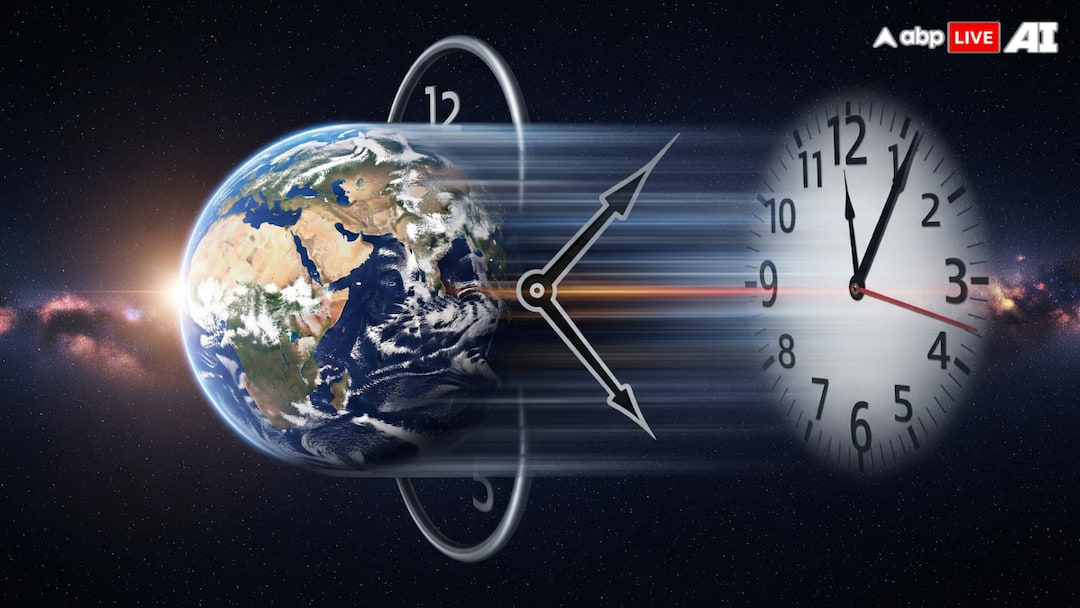
Today, July 22, Earth is spinning just a little quicker than usual. So quick, in fact, that the planet will complete a full rotation 1.34 milliseconds faster than the standard 24 hours. No, your clock won't glitch. But for scientists tracking Earth's spin down to the last fraction of a second, this is a big deal.
Let's break it down.
We're talking about one of the shortest days ever recorded since atomic clocks came into play back in the 1970s. And while this change is imperceptible in daily life, it fits into a strange and growing trend: Earth has been picking up speed in recent years. If the current pattern continues, experts may need to do something unprecedented — subtract a second from atomic clocks around 2029, reported Space.com. That's right, a negative leap second. Never been done before.
A Planet That Doesn't Keep Perfect Time
Contrary to what most people assume, Earth's rotation isn't locked into a perfect rhythm. It's been gradually slowing down for billions of years. Way back in Earth's early days, one full rotation took only about 19 hours. That was thanks to a push-and-pull between solar atmospheric tides and the moon's ocean tides.
Over time, the moon has drifted farther from Earth, dragging on our planet's rotation through tidal friction. That's why we now have 24-hour days, give or take a few microseconds.
But here's the twist: instead of continuing to slow, Earth has been speeding up lately.
Records Keep Getting Broken
From 1973 to 2020, the record for the shortest day stood at 1.05 milliseconds less than 24 hours. Then came 2020 and the Earth started breaking its own speed records again and again. The fastest spin so far happened on July 5, 2024, when Earth shaved off 1.66 milliseconds from the day.
This year, scientists expected July 9, July 22, and August 5 to be the front-runners for the shortest days. But updated data now shows July 10 stealing the crown, coming in at 1.36 milliseconds faster than the norm. That makes today (July 22) a close second.
As it stands, August 5 is projected to be about 1.25 milliseconds short, meaning July 22 holds onto that silver medal for now.
What's Actually Causing This?
That's the mystery. Researchers suspect a mix of factors could be at play — everything from changes in Earth's molten core to glacial melt, climate-related shifts in mass distribution, or even seismic activity. But nothing has been pinned down for certain.
What scientists do know is that the rate of acceleration seems to be slowing. Earth's days may still be running short, but not as drastically as they were in 2020 and 2021.
Why It Matters
To the average person, losing a millisecond here or there doesn't matter much. But for global systems that rely on hyper-precise timing, like satellite navigation, telecom networks, or financial trading, even the tiniest discrepancy can throw things off.
That's why the idea of a negative leap second has experts both intrigued and uneasy. Coordinating clocks worldwide is already complicated. Subtracting a second could make it even trickier.