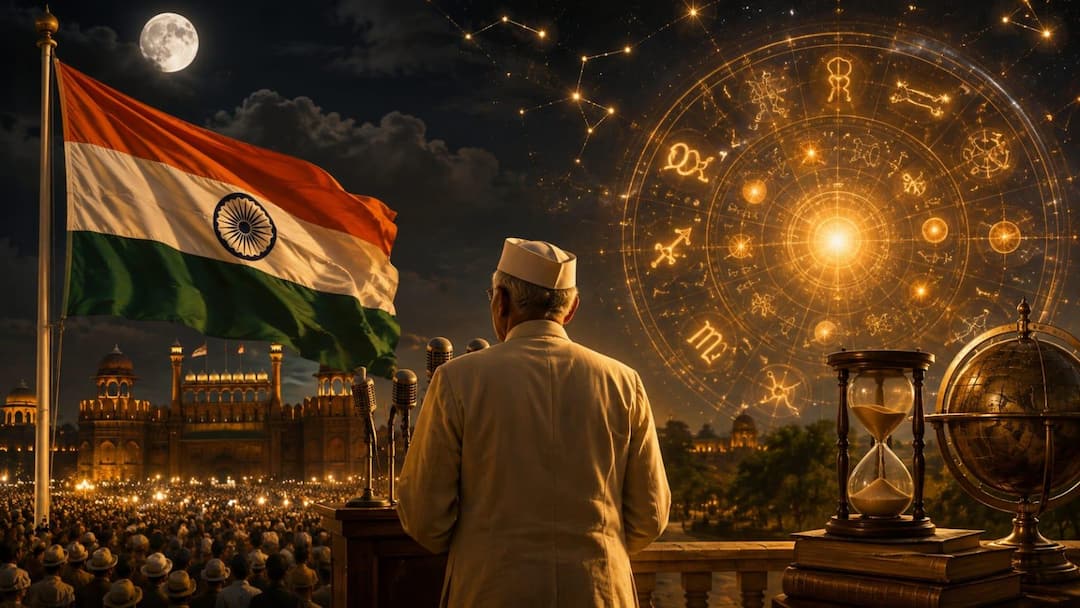
On the night of August 14, 1947, Delhi remained awake. Crowds thronged the streets, looking toward Parliament. As the clock ticked closer to 12, the grip of an empire was loosening. Inside the Constituent Assembly, Jawaharlal Nehru stood ready to deliver his historic speech. Outside, thousands awaited the voice that would allow them to call themselves citizens of a free India for the first time.
But why didn't India achieve independence in broad daylight? Why wasn't the transfer of power marked by the hoisting of the tricolor at the Red Fort? Why was that historic moment reserved for midnight?
It wasn't just Nehru's speech or the formality of British law that was behind this. The story involved Lord Mountbatten's insistence, the concerns of Indian astrologers, and the time-honored search between the hands of a clock, which opened the door to an auspicious moment within a date considered inauspicious.
The British Had Decided The Date; India Had To Choose The Time
In February 1947, British Prime Minister Clement Attlee announced that British rule in India would end by June 1948. However, after arriving in India, Lord Mountbatten realized that the British did not have that much time.
The country was spiraling into communal violence. Punjab and Bengal were burning. The prospects for a compromise between Congress and the Muslim League had collapsed. The British administration was crumbling. In these circumstances, Mountbatten pushed back the transfer date by almost ten months.
ALSO READ | PM Modi’s Independence Day 2026 Speech: ABP Live Predicted These Big Announcements
The date chosen was 15 August 1947. This was no ordinary day for Mountbatten. Exactly two years earlier, on August 15, 1945, Japan had announced its surrender to the Allies. Mountbatten was the supreme commander of the Allied forces in Southeast Asia during that war. This date was associated with his military success.
Mountbatten had already announced the date. Subsequently, the Indian Independence Act of 1947, passed by the British Parliament, also recorded August 15 as the birth date of India and Pakistan. Now, changing the date wasn't easy. But the calendar created a new complication.
Astrologers Expressed Concern After Seeing The Date Of August 15
According to popular accounts, as soon as the date of independence was announced, many astrologers in the country expressed concern about its auspicious time. They argued that just as a person's birth time determines their horoscope, the moment of a nation's founding is linked to its future direction.
Two names stand out prominently in this story, Pandit Hardev Sharma Trivedi of Solan and Pandit Suryanarayan Vyas of Ujjain. It is said that he conveyed to the leaders of the day that the entire day of August 15th was not considered auspicious for the birth of a nation. At that time, the Chaturdashi of the dark fortnight (Krishna Paksha) was nearing its end, and the new moon was approaching. In Muhurta astrology, the date, constellation, and ascendant are given special consideration for the establishment of a state, the accession to power, and the beginning of a new nation.
ALSO READ | Hariyali Teej 2026 Wishes: Best Wishes, Quotes, Messages To Share With Loved Ones
The problem was that the British were unwilling to change the date. The Indian leadership now had only a few hours' window. The date will remain with the British, but India will choose the time of independence within it. Found a way out of a bad date in the middle of the night
Astrologers observed the movements of the planets from the night of August 14th to the morning of August 15th. They were looking for a stable ascendant, a time in which the foundation of a new nation could be laid. The counting stopped around midnight.
At midnight, the date on the English calendar would change. August 14th would end, and August 15th would begin. This meant that the British law's requirements would be met. At this very moment, the Taurus ascendant was rising in the Delhi sky. Taurus is a fixed sign. In astrology, work begun in a fixed ascendant is considered durable and long-lasting. For a country born amidst division, violence, and displacement, there was hardly a better option than a fixed ascendant at that time.
Therefore, the transfer of power was scheduled for around midnight. This was a way to balance the date and auspicious time, without violating British law and without completely ignoring Indian tradition.
What Did Taurus Ascendant Change In India's Horoscope?
The popular horoscope for independent India is based on August 15, 1947, at midnight, and New Delhi. This horoscope has Taurus as its ascendant. Taurus is ruled by Venus. This sign is associated with land, resources, wealth, agriculture, art, and cultural identity. Perhaps it was a coincidence that the ascendant of the independence horoscope of the country, once called the Golden Bird by the British, also fell in a sign associated with material resources and the earth.
But Rahu was also placed in this ascendant. In astrology, Rahu is considered a factor of instability, mystery, illusion, foreign influence, and sudden change. India's birth, too, was not under normal circumstances. Independence brought partition. Millions of people became strangers in their own homes overnight. Borders were drawn on paper, and their pain lasted for generations.
Taurus ascendant, influenced by Rahu, seemed to be showing both the faces of that night: on one side freedom, on the other side the wound of partition.
Pushya Nakshatra Gave The Biggest Relief
That night, the Moon was in the sign of Cancer and under the influence of the Pushya Nakshatra. Pushya is considered an auspicious constellation in Vedic astrology. It is associated with nurturing, nourishment, expansion, and responsibility. The deity of Pushya is Jupiter, and the lord of the constellation is Saturn. Jupiter symbolizes wisdom and policy, while Saturn represents discipline, labor, and struggle. This combination was considered no small feat for a new nation.
In this horoscope, the Sun, Moon, Mercury, Venus, and Saturn were conjunct in Cancer, a sign associated with the motherland, the people, public sentiment, internal security, and borders. Looking at India's history, these issues have been central to its political life. Language, religion, borders, displacement, poverty, food security, public sentiment, and national unity have repeatedly grappled with these issues since independence.
Was Independence Achieved During Abhijit Muhurta?
Regarding the timing of independence, it is often said that India gained independence during the Abhijit Muhurta (the auspicious time of the moon). However, this claim needs to be interpreted with some caution.
In the general calendar, Abhijit Muhurta occurs in the middle of the day. The specific time at midnight is called Nishitha or Nishita Kaal. Some astrological traditions and later writings associated the time of independence with the Abhijit Kaal of the night. Not all calendar systems agree on this name. It's clear that midnight wasn't chosen solely for dramatic effect. The combination of Taurus ascendant and Pushya nakshatra within the designated timeframe of August 15th made the time more astrologically acceptable.
As Soon As The Clock Struck 12 Inside The Parliament...
On the night of August 14th, a special meeting of the Constituent Assembly began. The House was packed to capacity. There was barely any space even in the visitors' gallery. Pakistan had come into existence just hours earlier. There was jubilation in Delhi, but news from Punjab and Bengal tempered the joy.
Jawaharlal Nehru rose to speak. He declared that at the stroke of midnight, when the world sleeps, India will awake to life and freedom. The clock struck 12. The conch shell blew. The House erupted in applause. August 15th had begun. The Constituent Assembly assumed governing power, and one empire's legal authority over India had ended.
Interestingly, Mahatma Gandhi was not in Delhi at that historic moment of India's independence. He was in Calcutta trying to stop communal violence. While Delhi was preparing for celebration, Gandhi was fasting and praying. India's birth brought both celebration and mourning.
Did Midnight Save The Auspicious Time Or Create History?
India's independence wasn't the result of any planet or auspicious moment. It was the result of the struggle, imprisonment, protests, and sacrifice of millions. But the story of astrology's role in determining the timing of independence reveals an overlooked aspect of Indian history where modern politics and ancient tradition intersected.
Mountbatten chose the date. The British Parliament ratified it as law. Indian astrologers discovered a stable Taurus ascendant within the same date, and Indian leaders assumed power at midnight. That night, the clock didn't just change the date. It transformed a slave country into a free nation. On one hand, the sun of the British Empire was setting over India, and on the other, a new nation was being born in the night of the new moon.
Perhaps that's why the midnight hour of August 15, 1947, still evokes mystery. India woke without waiting for sunrise, because sometimes history chooses its daylight before dawn.
FAQs
Why did India gain independence at midnight?According to British law, India was to become independent on August 15, 1947. According to popular astrological interpretations, midnight was chosen to achieve a stable Taurus ascendant on this date.
Who decided on August 15th?Lord Mountbatten, the last Viceroy of India, chose August 15, 1947, for the transfer of power.
What is the ascendant of the horoscope of independent India?The popular horoscope based on the location of New Delhi at 12:00 a.m. on August 15, 1947, has Taurus as the ascendant.
Did India gain independence during the Abhijit Muhurta?This is a popular claim, but not all calendar systems agree on this. The specific period around midnight is commonly called Nishitha or Nishita Kaal.
Disclaimer: The information provided here is based solely on beliefs and information. It's important to note that ABPLive.com does not endorse any beliefs or information. Cons