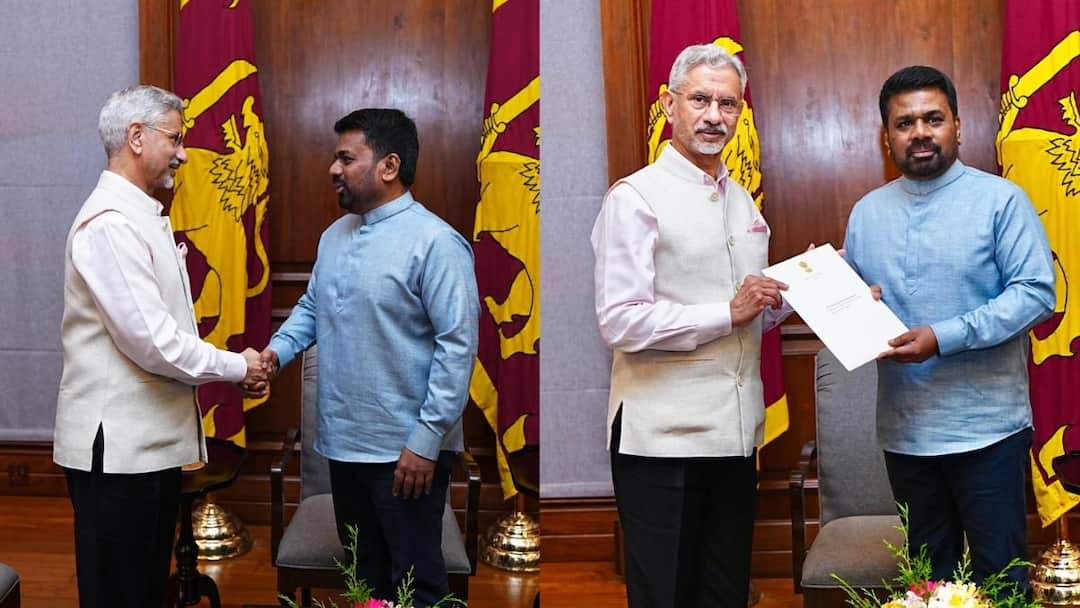
India’s External Affairs Minister S. Jaishankar on Tuesday visited Sri Lanka as a special envoy of Prime Minister Narendra Modi, holding talks with the island nation’s leadership and announcing a $450 million reconstruction package following the devastation caused by Cyclone Ditwah. The two-day visit underlined India’s Neighbourhood First Policy and its role as a first responder through Operation Sagar Bandhu.
Jaishankar said the assistance package comprises $350 million in concessional Lines of Credit and $100 million in grants, and is being finalised in close consultation with the Sri Lankan government. After meeting President Dissanayake, the minister said he conveyed a letter from Prime Minister Modi reaffirming India’s commitment to Sri Lanka’s recovery and rebuilding.
“As your closest neighbour and in line with our Neighbourhood First and MAHASAGAR policies, it was only natural that India step forward,” Jaishankar said, adding that India had also supported Sri Lanka during its recent economic crisis. He stressed that cooperative disaster response remains a key pillar of India’s regional approach.
The discussions, he said, focused on ensuring the assistance is delivered expeditiously and aligned with Sri Lanka’s most urgent priorities.
Operation Sagar Bandhu: Relief & Rescue Efforts
India launched Operation Sagar Bandhu immediately after Cyclone Ditwah made landfall and caused widespread damage across Sri Lanka. The Indian Navy deployed aircraft carrier INS Vikrant and INS Udaygiri to Colombo, delivering relief supplies. Indian Air Force Mi-17 helicopters operated in the country for over two weeks, while an 80-member National Disaster Response Force contingent carried out rescue operations.
The Indian Army set up a field hospital near Kandy with 85 medical personnel, providing emergency care to more than 8,000 people. Two modular BHISHM emergency medical units were also airlifted to assist relief efforts.
Rebuilding Focus & Future Support
Jaishankar said restoring connectivity was a priority, noting that Indian Army engineers erected a Bailey bridge at Killinochchi, with another under construction at Chilaw. Overall, India delivered more than 1,100 tonnes of relief material, including food, medicines, tents, hygiene kits and water purification equipment.
India’s reconstruction support will focus on housing, transport infrastructure, health and education systems, agriculture and disaster preparedness. Jaishankar said India would work closely with Sri Lanka to ensure swift implementation and also pledged continued support for the country’s tourism sector, a key pillar of its economy.