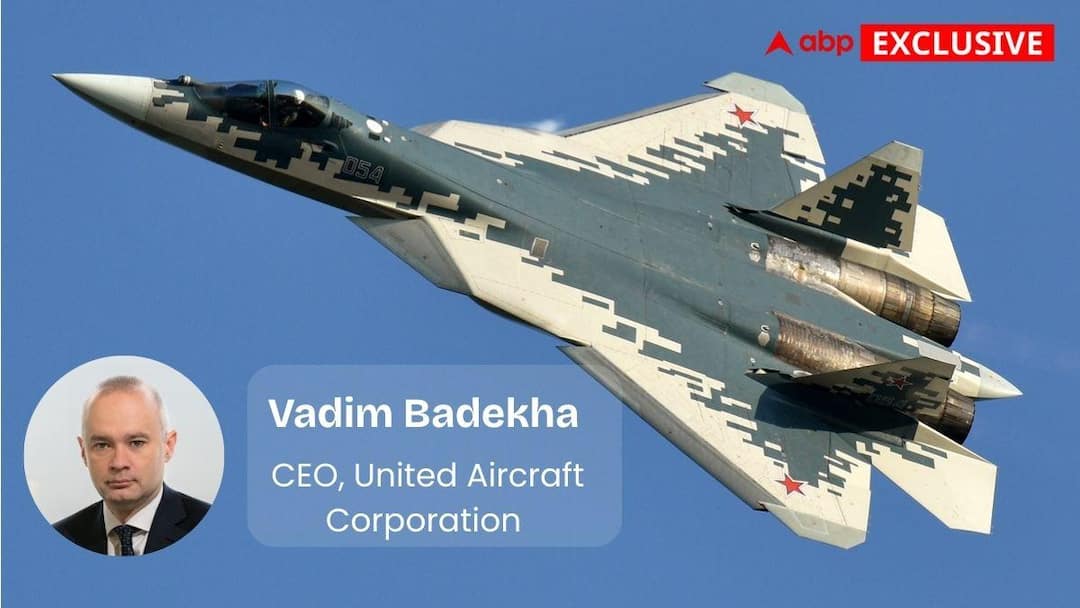
Russian aircraft maker United Aircraft Corporation (UAC) has said Russia is not only willing to pursue deeper technology transfer, but Moscow is also prepared to share the source code of the Su-57E stealth fighter with India, should New Delhi choose to procure the aircraft for the Indian Air Force (IAF), according to its CEO Vadim Badekha.
The Su-57E is the export version of the Su-57, which has generated considerable interest in the Indian market, particularly during its maiden appearance at Aero India 2025. The procurement of the Su-57, known by its NATO designation 'Felon', was also a topic of discussion during Russian President Vladimir Putin's visit to India earlier this month.
In an exclusive interview with ABP Live, Badekha said UAC has presented India with various options, including the direct purchase of a batch of Su-57E fighters as well as the option for licensed production in India, similar to the existing Su-30MKI program.
Edited excerpts:
Is India considering purchasing the Su-57E? What discussions are you having with Indian officials regarding this?
As far as we know, the Indian Air Force (IAF) is in need of modern fighter aircraft. The IAF recently retired its MiG-21 Bison, which had been in service for over 60 years. They should be replaced by modern Tejas Mk-1A fighters made by Hindustan Aeronautics Ltd. (HAL). However, as the IAF plans to go ahead with the decommissioning of the MiG-21, it is also looking at a future dominated by fourth and fifth-generation fighters.
There are a few countries in the world that not only produce their own 5th-generation fighters but are also willing to offer them to India on acceptable terms. India's development of its own aircraft, as we know from our own experience, will take time. Therefore, in our view, Russia remains India's only partner that meets all the requirements with Su-57E, both in terms of the product itself and in terms of its experience in joint production under the Make in India program.
India abandoned its previous plan to jointly develop the Su-57 in 2018. What has changed now?
The development of an aircraft of such technological complexity with such a volume of innovation is always risky. The Indian side's desire to minimise this risk is understandable. We’ve addressed those concerns and demonstrated that the aircraft has been developed and has proven its capabilities on the battlefield.
In terms of our willingness to cooperate, nothing has changed. Now the Su-57 is being supplied in series to the Russian Aerospace Forces, and we also already have agreements for export deliveries of the Su-57E.
Today's Su-57 is significantly different from the aircraft that first took to the skies 15 years ago. Over the years, the fighter has undergone a significant evolution and continues to improve, with the aircraft's weapons and systems capabilities expanding.
We have begun flight testing of a new engine – Product 177 – on the Su-57 aircraft. The new engine offers increased thrust and will enhance the Su-57's supersonic cruise capabilities, improve its overall performance, and improve its stealth characteristics.
What is the main advantage of the Su-57E?
The Su-57E is an aircraft with high modernisation potential and an open avionics architecture. In case the source code and design documentation for the Su-57E are transferred to India, and we are prepared to do so if the appropriate agreements are reached, Indian engineers will be able to independently customise and modernise the aircraft. The aircraft's spacious cargo compartments and high payload capacity can accommodate a wide range of weapons.
The Su-57 platform is designed to last at least 40-50 years, possessing all the qualities of a fifth-generation aircraft. Its open architecture allows it to implement a wide range of technologies with minimal changes to the core platform. The Su-57 platform is currently being modernised, and key technologies of the next, sixth generation will be developed on it. With the development of unmanned aerial vehicles for various purposes and their integration with manned aircraft, the Su-57 will become a central element of future combat systems.
Rosoboronexport is believed to be in talks with HAL regarding the joint production of the Su-57. How many aircraft will be produced in the initial stage?
Together with Rosoboronexport, we are offering the Indian side various cooperation options – from the direct purchase of a batch of aircraft to their licensed production in India, similar to the Su-30MKI program.
Russia has successful experience implementing programs from the MiG-21 to the Su-30MKI jointly with India, and I am confident that the transfer of this experience to the joint development of new generations of aircraft will continue the long history of successful cooperation between our countries, this time on the more advanced Su-57E.
We are prepared for a more in-depth technology transfer, and our Indian partners are also prepared to accept and utilise these technologies.
What kind of in-depth tech transfer?
Currently, we are capable of producing the Su-57 in sufficient quantities for both domestic and export needs. Our two countries not only enjoy long-standing diplomatic, trade, and cultural relations but also boast over 60 years of joint aircraft production. India has held the status of a special and privileged strategic partner of Russia for over 15 years. Therefore, I believe India will be the only country to which we offer such a comprehensive technology transfer.
To which all countries do you export the Su-57E?
You will soon receive the answer to this question when you see our aircraft in operation in other countries.
How do you plan to avoid Western sanctions?
India is a sovereign country, and its choice should not be conditioned by pressure from third parties. Furthermore, our countries conduct extensive trade and economic activities with direct Ruble-Rupee exchanges.
But critics claim that Su-57E is not combat-hardened.
These critics are either poorly informed or are biased by countries or companies engaged in unfair competition. The Su-57 is the only fifth-generation aircraft in the world that has been widely used in combat. The Su-57 clearly demonstrates Russia's unique capabilities in combat aviation. The characteristics built into this aircraft are proven in real combat.
Pilots of the Su-57 can use the most advanced weapons, including stealth cruise missiles. During combat, the fighter has demonstrated its effectiveness against air and ground targets, including precision strikes from long distances. It is used around the clock, in all weather conditions, and in challenging jamming environments.
What are your plans under the ‘Made in India’ program for the Su-57E?
Based on our long-standing partnership with India and our extensive experience, we are prepared to offer localised production in accordance with the Atmanirbhar Bharat (Self-Reliant India). This will help us skirt the sanctions that could disrupt the delivery of key aircraft components, as well as the absence of backdoors and Trojans in the software.