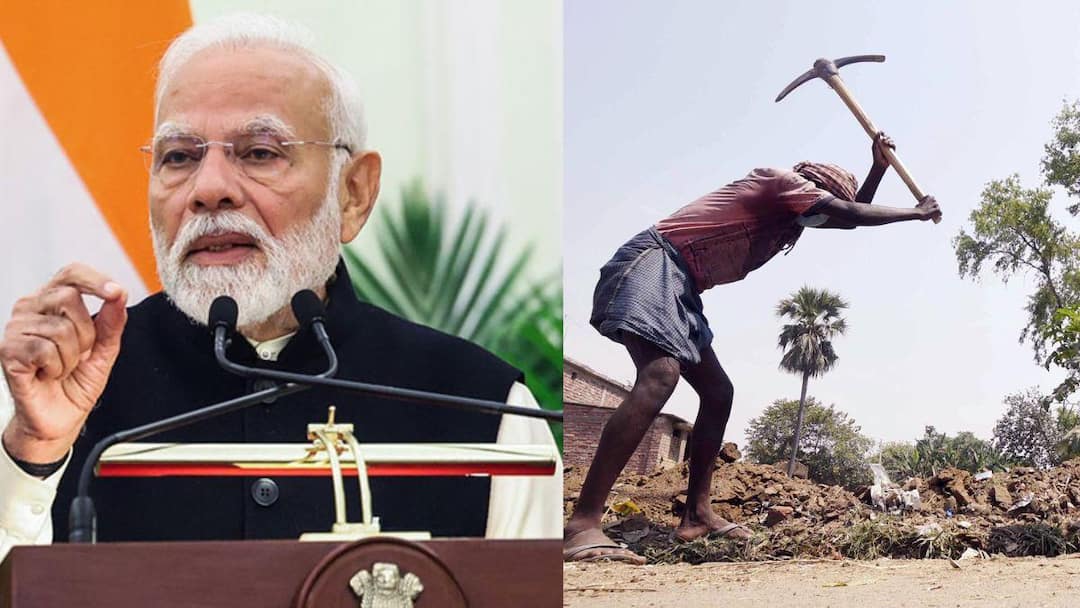
The Narendra Modi-led government has introduced legislation to replace the Mahatma Gandhi National Rural Employment Guarantee Act (MGNREGA), 2005 with a new scheme titled the Viksit Bharat Guarantee for Rozgar and Ajeevika Mission (Gramin) Bill, 2025, or VB–G RAM G. The Bill aims to establish a rural development framework aligned with the Viksit Bharat @2047 vision, providing a statutory guarantee of 125 days of wage employment in every financial year to each rural household.
This is for household whose adult members volunteer to undertake unskilled manual work, an increase from the 100-day guarantee under MGNREGA.
It also retains the provision for a daily unemployment allowance if employment is not provided within 15 days of an application. The scheme will be overseen by a newly constituted Central Gramin Rozgar Guarantee Council, comprising representatives of the Centre, states, Panchayati Raj institutions, worker organisations, and weaker sections, along with a Member-Secretary of at least Joint Secretary rank.
The proposed law will have an overriding effect over existing statutes but allows states with equivalent or superior employment guarantee laws to implement their own enactments.
Congress Criticises Removal Of Gandhi’s Name
The proposed repeal of MGNREGA’s name has drawn sharp criticism from Congress. Senior leader Priyanka Gandhi Vadra called the move unnecessary, saying it wastes public funds on stationery and paperwork and questioned the government’s priorities, noting that pressing issues are being ignored while Parliament remains inactive.
Brief History of MGNREGA
MGNREGA was enacted in 2005 under the UPA government led by Prime Minister Manmohan Singh, creating the world’s largest social security and public works programme by guaranteeing 100 days of wage employment to rural households. In 2009, the Act was renamed after Mahatma Gandhi to reflect his principles of dignity of labour, rural self-reliance, and grassroots empowerment.