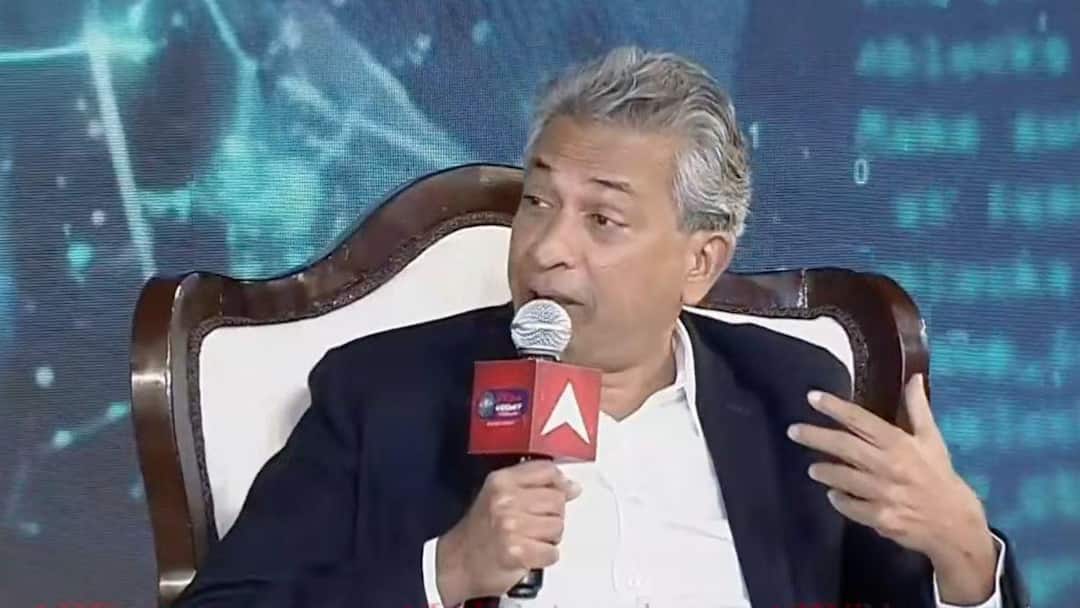
India's journey to becoming a developed nation will be driven by artificial intelligence. But the country must build and own that technology itself, not remain a consumer of what others create.
The argument is coming from someone who has spent decades shaping India's technology story. Rajan Anandan, Managing Director at Peak XV and Surge, and former head of Google India and Southeast Asia, brought that message to ABP Network's India @ 2047 Conclave in New Delhi on Wednesday.
Speaking at the session titled 'AI for India: The Future is Frugal and Local', he said, "We are just three years into generative AI. We are very early. And I am extremely bullish about what India is going to achieve. India today has more consumer AI startups than the United States. The fastest-growing AI education company in the world is Indian. But we cannot copy the current model of expenditure on AI."
A Father Who Swam The Palk Strait
Before Anandan became one of India's most prominent voices in venture capital, there was a father who taught him what it meant to push limits.
His father was an attorney, a Guinness World Record holder, and a swimmer who crossed the Palk Strait between Sri Lanka and India in 51 hours. He later died attempting to swim the English Channel. Anandan spoke about him with visible emotion and with a clear sense of what that legacy meant.
"His real passion was endurance sports. The lesson I took was simple: if you set your mind to something, you can achieve it. But you should also know what your limits are." As a child, he said, he was told to do 100 pushups to earn a bicycle. The principle stuck.
What Is AI, Really?
The session's host drew a parallel between artificial intelligence and Maya, a concept from Indian philosophy that refers to illusion. It is also the name of Anandan's daughter. The question was direct: is AI an illusion, a solution, or humanity's next great tool?
Anandan did not hesitate. "The simplest way to think about it is machines that have intelligence, fast approaching human intelligence." On a scale of one to ten, he placed AI at six today. But the direction is clear.
He described the launch of ChatGPT as a "magical experience." Tasks that would take him or a teammate days could suddenly be done in seconds. "Humans move on to do other things," he said, framing AI not as a replacement but as a multiplier.
Also Read: Why Is The Stock Market Falling Today? Sensex Sheds 1,000 Points, IT Stocks Crash
India Is Not Renting The Future
The harder question followed. Most Indians today rely on ChatGPT, Gemini, Claude, and Grok, all built outside India. Is the country building its own future or merely renting one?
Anandan pushed back firmly. India is winning, he said, and the evidence is already visible.
He pointed to the rise of Indian voice AI products that are highly cost-effective, the India AI Mission, and the fact that the country currently has 12 foundational model efforts underway. China has 10. He called out Sarvam by name, arguing that for India-specific use cases, it already outperforms ChatGPT. "The Jio moment for AI is happening as we speak," he said.
He also offered a specific, striking prediction. Within four weeks, an Indian company will launch a video model that is cheaper than any other in the world. "I can tell you five years from now, the lowest cost rocket launches will be happening in India."
The goal, he said, must be sovereign AI. India needs its own models, its own infrastructure, and its own research base.
The Opportunity For Founders
When asked what it would take for a 22-year-old to walk in and get a cheque from Peak XV, Anandan's answer was precise. Show deep insights. Build fast. Ship fast.
He was equally direct about what is missing. India needs more AI founders. "This is a generational opportunity." The mindset shift required, he said, is moving from building to survive to building to be number one.
Every industry, he argued, is in the middle of an AI-driven transformation. He compared the current moment to the beginning of the industrial revolution. Healthcare, education, and media were among the sectors he singled out. "The media business will be completely reimagined."
Also Read: India Services PMI Climbs To 59.8 In May As Demand For IT, E-Commerce, And Freight Surges
India's Optimism Is A Strategic Asset
Anandan contrasted global mood with India's. Public sentiment around AI in the United States is increasingly anxious. He noted that AMD CEO Lisa Su recently received a negative reaction at MIT. India, he said, is in a different place entirely.
"India is fundamentally optimistic. 1.4 billion Indians embrace technology to make their lives better." That cultural openness, he argued, is itself a competitive advantage.
He also offered a longer horizon. If you survive the next 15 to 20 years, he said, medical advances will likely extend human life to 150 years. He expects a cure for cancer. "We will have a cure for every disease we know."
What India Must Do Next
Anandan closed with two asks directed at policymakers. First, take the India AI Mission and scale it tenfold. Second, invest urgently in AI researchers. India currently has only a few hundred. The country needs a mission-driven effort to bring back Indian AI talent from abroad.
For young Indians entering the workforce, his advice was straightforward. Focus on computer science. But be savvy about it. The big IT companies will pivot. The question is whether India's next generation will lead that pivot or follow it.
Also Read: Viksit Bharat Needs 9% Growth, Not 6%: Surjit Bhalla At ABP's India@2047 Conclave