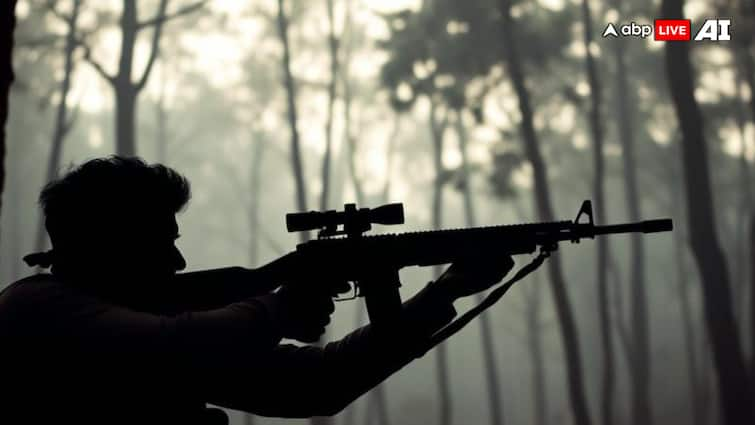
Two security personnel lost their lives and another was injured in an overnight gun battle with Maoist rebels in Jharkhand’s Palamu district early Thursday. The clash broke out around 12.30 am when security forces came under heavy fire from members of the Tritiya Sammelan Prastuti Committee (TSPC), a breakaway Maoist faction.
Palamu Deputy Inspector General Naushad Alam confirmed the casualties, saying, “Two security personnel were killed and another was injured in the gunfight. The injured has been admitted to Medinirai Medical College and Hospital.”
According to police, the encounter began after a team of security forces launched an operation following intelligence inputs on the presence of TSPC commander Shashikant Ganjhu and his squad in Kedal village. As soon as the forces reached the location, the rebels opened fire, triggering a fierce exchange. Three personnel were hit during the gunfight; two of them were later declared dead at the hospital.
The incident comes at a time when anti-Maoist operations have been stepped up across several states, with the government setting an ambitious target of eliminating the insurgency by next year. The proscribed Communist Party of India (Maoist), the parent organisation from which several splinter groups have emerged, has already suffered major setbacks.
A Central Committee document released on June 23 revealed that 357 Maoists had been killed over the past year in intensified security operations, particularly in Chhattisgarh. On May 20, Maoist chief Nambala Kesava Rao, better known as Basvaraju, was killed in a forested area of the state — a blow described as the most significant in years against the Left-wing insurgency.
Basvaraju, the general secretary of the Maoists, was considered the backbone of the movement in central India. He was accused of orchestrating several deadly attacks, including the 2010 ambush that claimed the lives of 76 security personnel.
The Maoist movement traces its roots back to 1967, when it first emerged in the Naxalbari village of West Bengal. Over the decades, it spread across several states, including Chhattisgarh, Jharkhand, Bihar, Odisha, Andhra Pradesh, and Maharashtra.
20 Maoists Surrender In Chhattisgarh
Meanwhile, 20 rebels laid down arms in the Sukma district of South Bastar in Chhattisgarh on Wednesday. Eleven of them were on the wanted list, carrying a combined reward of Rs 33 lakh.
Among those who surrendered were two prominent Maoist leaders: Sharmila alias Uika Bhime and Tati Kosi alias Pramila. Both were considered hardcore operatives and carried a bounty of Rs 8 lakh each. Sukma Superintendent of Police Kiran Chavan said Sharmila was part of the Maoist People's Liberation Guerrilla Army (PLGA) battalion number one, while Tati was linked to the CPI (Maoist)’s west Bastar division.
Another key figure, Muchaki Hidma, an area committee member, also gave up arms. He carried a bounty of Rs 5 lakh. Police added that four other cadres had a Rs 4 lakh reward each, while several others were wanted with a bounty of Rs 1 lakh.
This mass surrender in Sukma comes just a week after 30 Maoists abandoned the insurgency in Bijapur, another district in south Bastar. In July alone, 66 Maoists had surrendered across five districts of the Bastar region.
According to official data, as many as 1,686 Maoists have surrendered in Chhattisgarh over the last 18 months, marking a significant blow to the outlawed CPI (Maoist) network in the state.