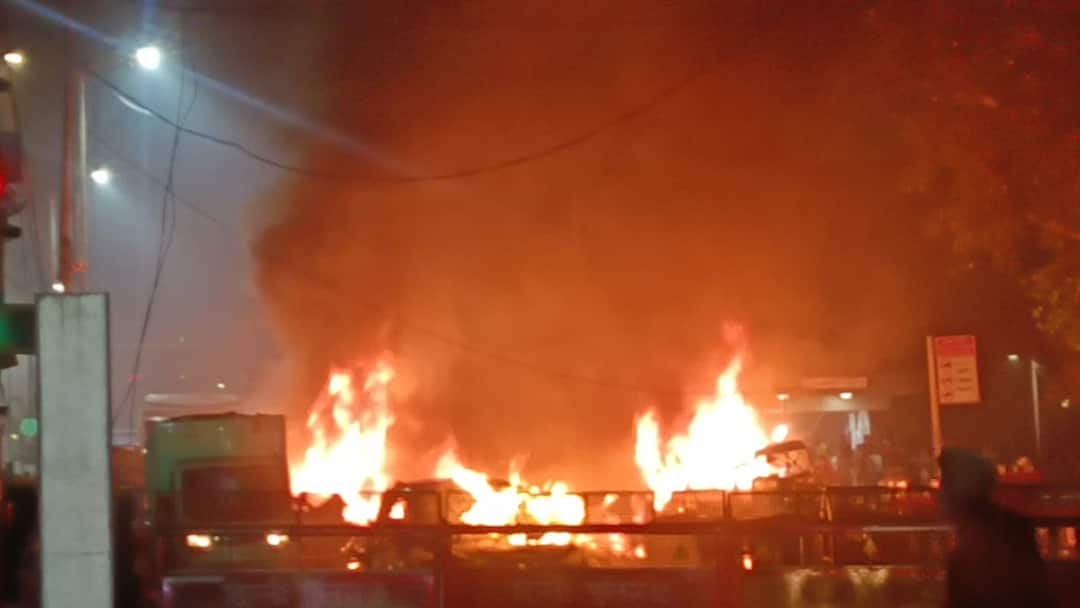
In a stunning revelation, investigators have found a link between the deadly blast near Delhi’s iconic Red Fort, which killed nine people, and the “white collar” terror module recently busted by police teams from Jammu and Kashmir and Haryana.
Top sources confirmed early Tuesday that the car which exploded was owned by Dr Umar Mohammad, a resident of Pulwama in south Kashmir, who was allegedly part of the same module.
The blast is now being probed as a terror attack, with the Delhi Police invoking Sections 16 and 18 of the Unlawful Activities (Prevention) Act (UAPA), pertaining to acts of terrorism and related offences. They have also added Sections 3 and 4 of the Explosive Substances Act, along with charges of murder and attempt to murder.
Dr Umar Panicked, Detonated Explosives
According to investigators, Dr Umar panicked and detonated the explosives near the Red Fort after police arrested two key members of the module, Dr Mujammil Shakeel and Dr Adil Rather, and seized 2,900 kg of suspected explosives from Faridabad over the past few days.
Sources said the target could have been anywhere in central Delhi, as the car was seen moving from the Red Fort toward the city centre. Preliminary analysis suggests that ammonium nitrate, commonly used in fertilisers but also in bomb-making, was used in the explosion.
The blast occurred just hours after the Jammu and Kashmir and Haryana Police recovered thousands of kilos of suspected explosives and a cache of arms and ammunition from two houses in Faridabad, both rented by Dr Shakeel.
Police Commissioner Satish Golcha told reporters, “A slow-moving vehicle stopped at a red light, an explosion occurred in that vehicle, and due to the blast, nearby vehicles were also damaged.”
The explosion site, close to Chandni Chowk, one of Delhi’s busiest markets, was strewn with mangled bodies and debris. At least six cars and several motorised rickshaws were engulfed in flames.
Multi-Agency Probe Underway
A massive multi-agency investigation is now underway, involving the Delhi Police, J&K Police, NIA, NSG, Intelligence Bureau, UP ATS, Haryana Police, Gujarat Police, and forensic teams.
The J&K Police have detained a man named Tariq in Pulwama. Initial questioning suggests the vehicle changed hands multiple times, from Aamir to Tariq, and finally to Umar. Officials expect more clarity by Tuesday afternoon as the interrogation continues.
Police sources revealed that the J&K Police had been tracking the Jaish-e-Muhammad-linked module for the past 26 days.
Union Home Minister Amit Shah said on Monday night that “no possibility is being ruled out,” and that all angles — including terror links and cross-border involvement — are being investigated. Delhi remains on high alert, and suspects from the Faridabad module are being closely interrogated for possible connections to the blast that has rattled the nation.
The ‘White Collar’ Terror Module
The so-called “white collar” terror network, comprising radicalised professionals, was unearthed during raids across Srinagar, Anantnag, Ganderbal, Shopian, and Faridabad.
During the raids, police recovered 350 kg of explosives, 20 timers, assault rifles, handguns, and ammunition from a room rented by Shakeel in Dhoj for the past three and a half years.
A second raid in Fatehpur Taga village, four kilometres away, led to the seizure of an additional 2,563 kg of suspected explosives. Together, the operations yielded over 2,900 kg of bomb-making material.
Officials say the module was being remotely operated by handlers in Pakistan and other countries, with its members engaged in both logistical and propaganda activities, including circulating posters supporting terrorist groups.