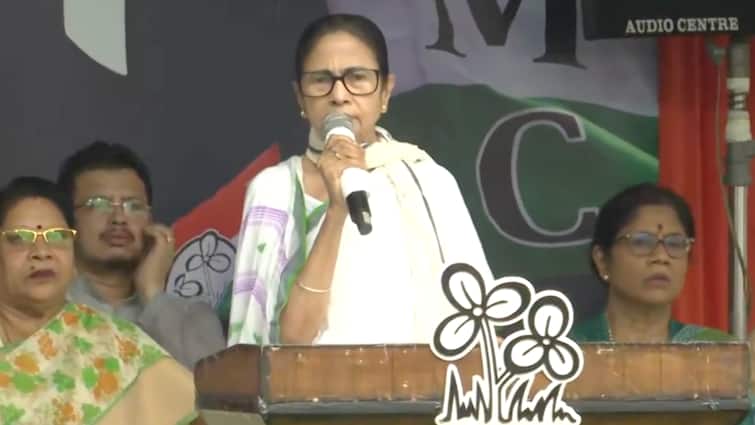
West Bengal Chief Minister Mamata Banerjee kicked off her high-profile 'Bhasha Andolan' (Language Movement) from Bolpur on Monday, taking a bold stand against what she claims are rising attacks on Bengali-speaking migrants across India. The campaign, rooted in cultural identity and resistance, is being framed as a fight to preserve Bengal's language, dignity, and place in the nation's mosaic.
This wasn't just another political rally. The march, a symbolism of sorts, began at the Tourist Lodge crossing and ended three kilometres away at the Jamboni bus stand, right in the cultural heartland of Rabindranath Tagore's Santiniketan.
At the head of the procession was Banerjee herself, holding a portrait of Tagore close to her chest. She walked with purpose, waving to supporters as chants and songs filled the air. Party workers broke into “Ami Banglay Gaan Gai,” Pratul Mukhopadhyay's timeless anthem that's come to embody Bengali pride and protest. On both sides of the road, women in traditional white-and-red saris blew conch shells, transforming the march into a celebration of Bengali heritage as much as a political statement.
Banerjee, clad in her signature cotton sari and draped in the traditional uttariya of Visva-Bharati, was joined by senior Trinamool Congress leaders and ministers. This was just the first of many such rallies planned across West Bengal in the coming days.
By invoking Tagore and leading a culturally charged protest in Shantiniketan, Banerjee made her message unmistakably clear: any attempt to marginalise the Bengali language or identity won't go unanswered.