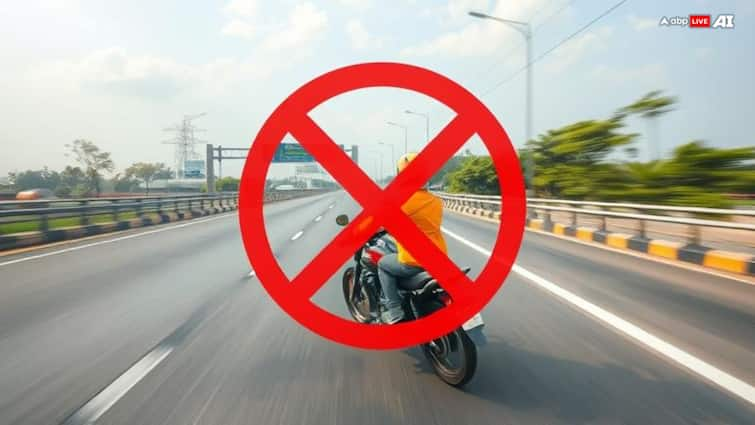
Bengaluru-Chennai Expressway News: The National Highways Authority of India (NHAI) has imposed a ban on the entry of two-wheelers on the recently opened Bengaluru-Chennai Expressway. The ban is in place, at least on the Karnataka stretch for now, to improve road safety, reported The Times Of India.
This decision follows a fatal accident on Sunday night in the Bangarpet taluk, Kolar, which claimed four lives.
To enforce the restriction, patrolling teams have been instructed to prevent bikes from accessing the expressway at entry and exit points. Additionally, signboards will be installed to make the ban clear to bike riders, an NHAI official confirmed.
How The Accident Occurred
According to an NHAI official quoted by TOI, a motorcycle got onto the expressway from the wrong side and hit a four-wheeler on Sunday, resulting in four deaths. "By law, two-wheelers are not allowed on expressways across the country. These roads are designed for high-speed travel, with speed limits reaching up to 120 kmph. The presence of motorcycles poses severe risk not only to the riders but also to other road users. We strongly urge bikers to avoid this stretch,” the official said.
Bengaluru-Chennai Expressway
The Bengaluru-Chennai Expressway, spanning 260 kilometres in total, has been partially opened for vehicular traffic, with 71 kilometers completed within Karnataka. The remaining stretch, running through Andhra Pradesh and Tamil Nadu, is expected to be operational by the end of the year. Within Karnataka, the expressway improves connectivity to key locations like Hoskote, Malur, and KGF.
The Bengaluru-Chennai Expressway has four lanes and is likely to have two toll plazas in Karnataka. Along with bikes, tractors and autos are also forbidden from using the main expressway.
This isn't the first time NHAI has taken such a step. Following a series of fatal accidents on the Bengaluru-Mysuru expressway, authorities also banned two-wheelers and autorickshaws from its main lanes.
“We also urge drivers of four-wheelers and larger vehicles to maintain safe speeds,” the official added. “Many motorists accelerate excessively when they see an empty stretch, increasing the likelihood of accidents.”
To further strengthen safety measures, NHAI plans to collaborate with district enforcement authorities. Patrolling teams and ambulances are already deployed along the expressway to respond to emergencies. However, full-fledged enforcement will only take effect once the toll notification is officially issued, the official noted.
With rising concerns over road safety, authorities continue to emphasize responsible driving and adherence to traffic regulations. As expressways become more prevalent, ensuring compliance with safety measures remains a top priority for both officials and motorists alike.