Germany is a pivotal logistics hub for NATO. It would facilitate the transit of hundreds of thousands of NATO soldiers, weapons, and heavy equipment moving through the country towards the eastern flank.
Explorer
Inside Germany’s Push To Strengthen NATO’s Defence Readiness
With around 1,700 participants, including 500 soldiers, the exercise held in late September 2026, was the largest of its kind to date.
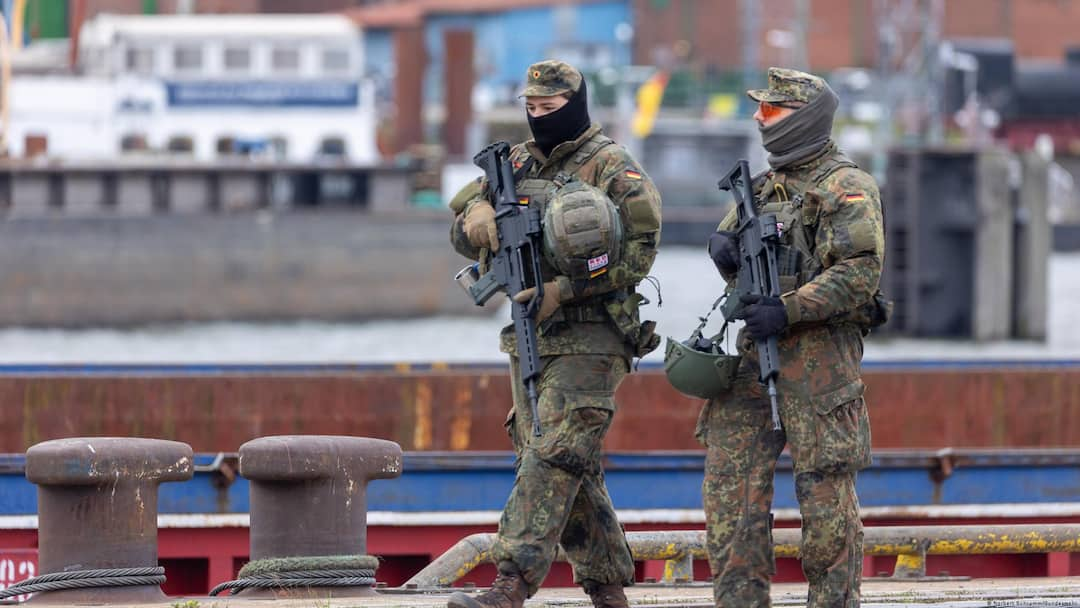
At the same time, the plan can only succeed through close cooperation between the Bundeswehr and civilian society, including local and regional authorities, the police, and relief organizations.
Source : DW
- Germany is a vital transit hub for huge NATO forces.
- Infrastructure upgrades and secrecy are critical challenges.
In a residential district of Hamburg at midnight, the streets are quiet and deserted. Suddenly, the silence is shattered: Several helicopters circle the night sky, and flashing blue lights illuminate the darkness. A long convoy of vehicles moves through the streets. Soldiers stand atop armored Bundeswehr vehicles, their machine guns at the ready. For local residents, it is an unusual, perhaps even unsettling sight in an otherwise peaceful port city.
"Red Storm Charlie" is the name of the exercise that will bring parts of Hamburg, northern Germany's largest city, to a standstill for three days. The Bundeswehr, police, and civilian organizations are jointly testing how well prepared they are to respond in a crisis.
The scenario centers on a deteriorating security situation on NATO's eastern flank. NATO troops, represented in the exercise by Bundeswehr soldiers, arrive at the port of Hamburg, Germany's largest seaport, before moving eastwards through the Hanseatic city.
Acts of sabotage and demonstrations, also included in the scenario, hamper their advance. With around 1,700 participants, including 500 soldiers, the exercise held in late September 2026, was the largest of its kind to date.
"Red Storm Charlie" forms part of a classified strategy known as the "Operationsplan Deutschland" (Operations Plan Germany). Through this document, the Bundeswehr is preparing for the possibility of a Russian attack on NATO territory. The Operations Plan Germany is an integral element of NATO's broader defense planning and is closely aligned with the Alliance's overall defense framework.
In the event of war or a major crisis, not only the city of Hamburg but Germany as a whole would assume a pivotal role as a logistics hub for hundreds of thousands of NATO soldiers, weapons, and pieces of heavy equipment. "This is a highly detailed and strictly classified plan that specifies exactly where NATO allies would arrive in Germany, including which ports they would use and which routes would be required for their transit across the country," security expert Aylin Matlé of the German Council on Foreign Relations (DGAP) told DW.
Germany as a transit country for NATO troops
The Baltic states are widely regarded as the region where NATO considers a Russian attack most likely. In such a scenario, the alliance would concentrate large troop contingents from its 32 member states there. To reach the region, soldiers from southern and western Europe would need to pass through Germany. "In concrete terms, this means that around 800,000 soldiers and 200,000 vehicles would have to move through our country within six months. Those are the calculations," says Marcel Bohnert, a Bundeswehr officer who contributed to the first version of the Operations Plan.
Speaking to DW in a personal capacity rather than as a representative of the Bundeswehr, Bohnert explained: "We must ensure that soldiers can use our roads and ports safely. That is why we take care of all their needs: We arrange accommodation, provide food, ensure their security, and guide them through our transport network."
The plan also covers transport in the opposite direction, from east to west, including the evacuation of wounded soldiers and civilians fleeing the conflict. Its development was commissioned by Bundeswehr Inspector General Carsten Breuer in the wake of Russia's full-scale invasion of Ukraine in 2022. As Germany's highest-ranking military officer, Breuer is far from alone in his concern that Russia could target additional countries. Germany is already confronting a wide range of Russian hostile activities, from cyberattacks to acts of sabotage directed against the Bundeswehr.
Defense Minister Pistorius: 'Moscow is testing our response'
A new dimension of the threat emerged with the attempted attack at Leipzig/Halle Airport in early August. An explosive-laden drone was deployed there and failed to detonate only through luck. The German government holds Russia responsible. "The threat is becoming more tangible. It is serious, acute, and increasingly visible. This is exactly what the Russian president wants. Moscow is testing our response," Defense Minister Boris Pistorius of the center-left Social Democratic Party (SPD) told the Bundestag on September 23.
The Bundeswehr is also addressing this threat through the Operations Plan Germany, which is continuously being refined and updated. Lessons learned from exercises such as "Red Storm Charlie" are incorporated into the plan. According to Bohnert, the plan also serves as a deterrent: "We hope to discourage Russia from further aggression by demonstrating our strength through the rapid build-up of military capabilities and the highly organized, swift deployment of forces to the borders."
Roads and bridges need upgrading
How well prepared is Germany for its role as a military logistics hub? Matlé identifies one major vulnerability in the country's ageing and, in some cases, deteriorating infrastructure. Germany, she argues, must address the maintenance and repair of the bridges, roads, and transport routes required for troop movements "far more quickly and comprehensively." "Some of this infrastructure dates back to the Cold War and was not designed to accommodate heavy loads or military equipment."
A further challenge lies in striking the right balance between confidentiality and public involvement. To guard against acts of sabotage, sensitive details such as the precise transit routes for NATO troops must not fall into Russian hands. At the same time, the plan can only succeed through close cooperation between the Bundeswehr and civilian society, including local and regional authorities, the police, and relief organizations. "Parts of the plan must be publicly accessible because we need support from society, as well as from ministries and governments, to make it work," said Bohnert.
Could the AfD pass on sensitive information?
The debate over the confidentiality of the more than 1,000-page document recently resurfaced after the far-right Alternative for Germany(AfD) emerged as the strongest party in recent elections in the eastern German state of Saxony-Anhalt.
Security experts expressed concern that the party, which is classified in part as right-wing extremist and is regarded as Russia-friendly, could pass information from the plan to Moscow if it were to assume the office of state premier. The Defense Ministry rejected these concerns, noting that no federal state is given access to the complete document. Instead, the sensitive sections of the Operations Plan are shared only in excerpts and strictly on a need-to-know basis.
According to observers, however, the growing number of hybrid threats is underscoring the need for secrecy. During the "Red Storm Charlie" exercise in Hamburg, accredited journalists were not informed of routes or locations until the very last moment because of concerns over potential disruptions and acts of sabotage.
This article was originally written in German.
(Disclaimer: This report first appeared on Deutsche Welle, and has been republished on ABP Live as part of a special arrangement. Apart from the headline, no changes have been made in the report by ABP Live.)
Frequently Asked Questions
What is Germany's key role in NATO's defense plans?
What challenges does Germany face in its role as a military logistics hub?
Germany faces challenges with its aging infrastructure, like roads and bridges, which may not accommodate heavy military equipment. Balancing confidentiality with public cooperation is also a significant hurdle.

Advertisement
Top Headlines
World

France Sees Fresh Protests Over Rising Living Costs, Thousands March Nationwide
World

ASEAN Leaders Agree To Re-engage Myanmar In Stages, Link Return To Peace Progress
World

‘There Wasn't Much Trust’: Joe Biden Opens Up About Relationship With Netanyahu
World

Xi-Trump-Putin Summit: Why China Is Cautious About A 'New Yalta' Meeting


Advertisement









Advertisement